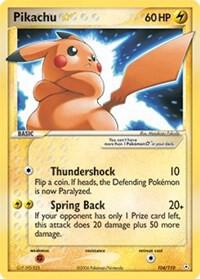
Pikachu Star from Holon Phantoms moved 81% in seven days. That is a number worth looking at carefully, both for what the data confirms and for what it does not.
The numbers at a glance
Pikachu Star (#104/110 from Holon Phantoms) is currently priced at $3,200.00. Seven days ago the same card sat at $1,765.48, a difference of $1,434.52. That works out to an 81.25% gain over the seven-day window. The numbers are straightforward. The reasons behind them are less so.
What Star cards are and why they carry a premium
Star cards are a class of rare Pokemon cards introduced during the EX-era sets, identifiable by a gold star symbol next to the Pokemon's name and featuring alternate-color artwork. Each Star card was limited to one per set, which made the print run extremely thin relative to most rare cards from the same period. Scarcity of that kind tends to be durable: copies do not suddenly appear.
Pikachu is broadly considered one of the most recognized characters in the Pokemon franchise. That recognition places a consistent collector premium on high-grade Pikachu cards across eras, and a Pikachu Star sits at the intersection of character demand and structural scarcity.
Possible drivers of the move
The current data snapshot does not include sale volume or graded-population figures, so any specific cause for the 81.25% move must be treated as hypothesis rather than confirmed fact. A single high-visibility sale, a graded auction result, or renewed social-media attention on vintage EX-era cards could each apply upward pressure this quickly. Without sale-count data, none of those explanations can be confirmed.
This is also a structural point about low-liquidity cards. When very few copies change hands in a given period, even one or two transactions can shift the observable price sharply. The move is real in the data. The cause is not yet visible in the data.
Blip or trend: how to think about it
The available data covers a single seven-day window, a move from $1,765.48 to $3,200.00. That is not enough history to distinguish a sustained re-rating from a short-term spike. Both outcomes are consistent with what the numbers show.
Vintage EX-era Star cards broadly hold long-term collector demand, so a partial consolidation from the current level would not necessarily mean the move is fully reversed. A card can settle below its peak and still be trading above its prior range for legitimate reasons. The key question is whether the $3,200.00 price is supported by subsequent sales or drifts back toward the prior range near $1,765.48 over the coming weeks. That answer requires more data than one week provides.
Buyer and seller considerations
Buyers entering near $3,200.00 are paying roughly double the price seen just seven days ago at $1,765.48. On a card with thin liquidity, that gap matters. Position sizing and exit planning are more important than usual when the spread between entry and any plausible reversal point is this wide.
Sellers who have held the card through the move face a different version of the same question: does the $1,434.52 gain reflect a new market consensus, or is it an overshoot that may partially correct? Neither answer is obvious from price data alone.
For both sides, the most useful next data points are graded-population reports from major grading services and recent completed auction results. Neither is available in the current snapshot, but both would add meaningful context to whether this price level has real support or is resting on a single transaction.
Check the TCGIQ app for live pricing on Pikachu Star and the rest of the Holon Phantoms set.